Supporting the Implementation of Civil Initiatives in the New Subjects of the Russian Federation
The year 2023 marked a stage of integrating historical territories into the country's unified humanitarian, legal, and socio-political space.
In June 2023, a new composition of the Civic Chamber began its work. For the first time, it included representatives from the DPR, LPR, Zaporozhye, and Kherson oblasts—Anna Revyakina, Viktor Ryabichev, Vladimir Rogov, and Vladimir Ovcharenko.
The Civic Chamber continued its work on integrating the civil society of the new subjects with that of Russia. A unified database of nonprofit organizations from the new territories was created, educational and methodological programs were launched, and direct informational support was provided.
For nonprofit organizations and public associations from the new regions, the three-year existence requirement for nominating candidates to public councils under federal executive bodies was lifted.
As part of the project "Supporting Public Initiatives in the New Territories of Russia," resource centers in the Lugansk and Donetsk People's Republics, Zaporozhye, and Kherson oblasts have significantly boosted the activity of the nonprofit sector and created a favorable environment for implementing various social initiatives and projects.
The Coordination Council for the Integration of the New Subjects of the Russian Federation began its work on the Civic Chamber's platform. It brought together civil activists, opinion leaders, and expert practitioners. The Council has become a platform for direct dialog, sharing best practices, and facilitating solutions to specific tasks.
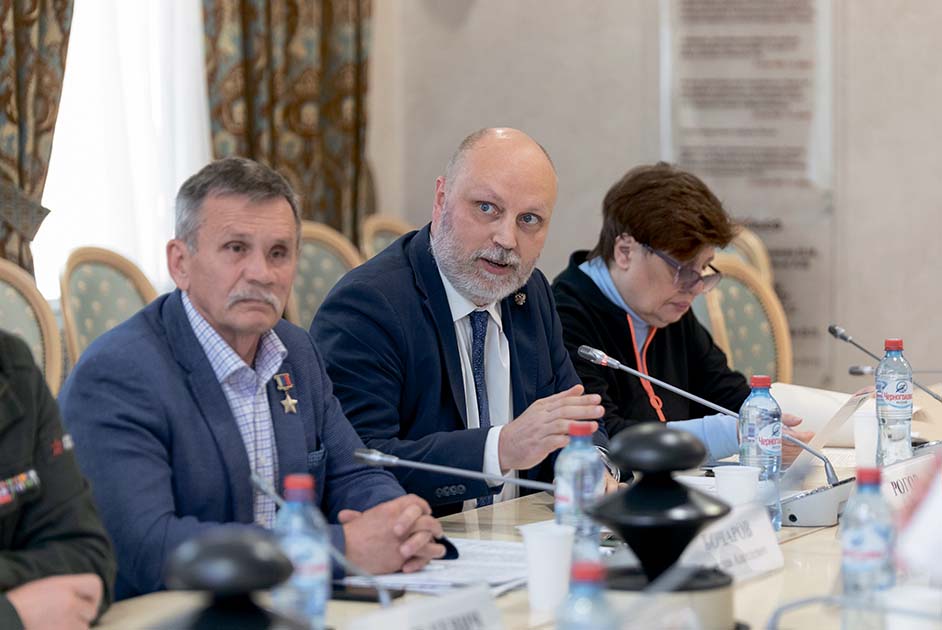 Members of the Civic Chamber Vladimir Rogov and First Vice President of the Civic Chamber, Hero of Russia Vyacheslav Bocharov, at a meeting of the Coordination Council for the Integration of the New Subjects of the Russian Federation. July 2023 / Press Service of the Civic Chamber of the Russian Federation.
Retraining, Social Adaptation, and Mental Health Services to SMO Participants
The Civic Chamber of the Russian Federation has focused special attention on developing comprehensive approaches to the social adaptation of participants in the special military operation, supporting their families, and providing humanitarian aid to residents of the new subjects of the Russian Federation.
At the end of 2022, during the "Community" forum, participants decided to establish the Committee of Families of Warriors of the Fatherland (CFWF)—an organization aimed at implementing programs and projects to support the families of SMO participants. Human rights advocate Yulia Belekhova became the head of the CFWF, and its branches were soon established across the country.
In 2023, with broad participation from the scientific, professional, and expert communities, a series of events on the Civic Chamber's platform extensively discussed topics such as comprehensive rehabilitation of active and discharged military personnel and veterans, wide-ranging opportunities for their professional retraining, professional aspects of providing psychological assistance, and the need to create support communities for sharing experiences in this field.
Throughout 2023, many ideas and initiatives proposed during the Civic Chamber's events were translated into specific state decisions.
Traditional areas for implementing humanitarian initiatives in 2023 included the collection and procurement of humanitarian aid.
Members of the Civic Chamber organized the dispatch of humanitarian convoys carrying medical equipment and a wide range of humanitarian supplies to the new regions. They were involved in organizing cultural and educational leisure activities for military personnel and their families, as well as for citizens of the new subjects of the Russian Federation, such as organizing musical concerts, sports competitions, professional master classes, and educational training sessions. A crucial focus of the Civic Chamber members' efforts was on informational, cultural, and historical projects within the new territories.
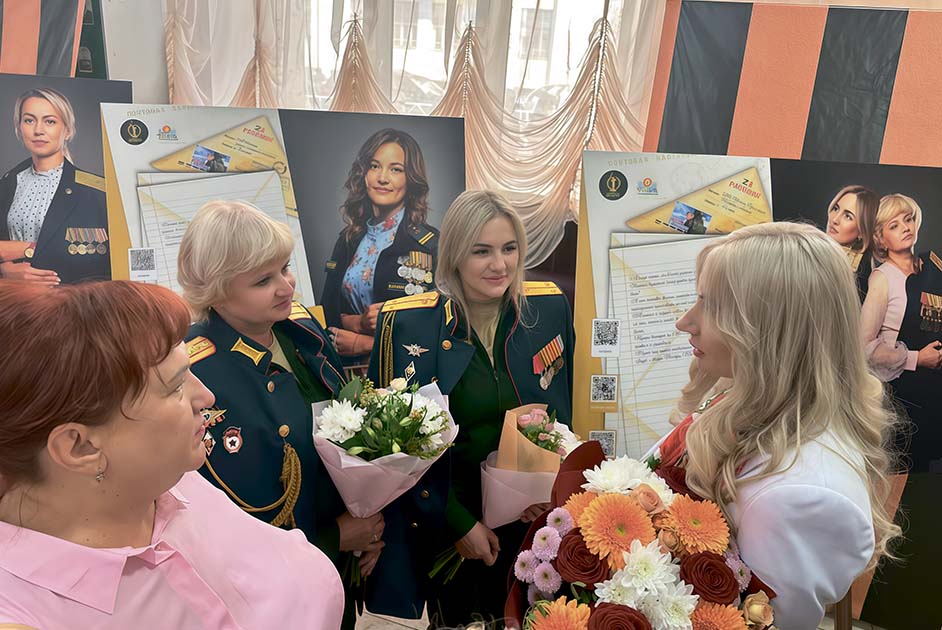 Member of the Civic Chamber of the Russian Federation, Ekaterina Kolotovkina, at the opening of the photo exhibitions "Wives of Heroes" and "Faces of the Army" at the Samara Officers' House. September 2, 2023 / Press Service of the Civic Chamber of the Russian Federation
New Approaches to Patriotic Education
In 2023, patriotic education became one of the priority themes in the public-state agenda, gaining the status of not merely an educational activity but a key vector for shaping national identity and civic responsibility.
On the platform of the Civic Chamber, substantive discussions continued, aimed at comprehending the tasks facing all participants in this process, including relevant federal executive authorities, educational institutions, public associations, and professional communities. Special attention was paid to improving the cycle of extracurricular classes, "Conversations about Important Things," which has become a significant tool for dialog between general education institutions and the younger generation about the core values of modern society. Members of the Civic Chamber actively participated in developing methodological materials for the cycle of extracurricular classes, organizing teacher training, and providing expert evaluation of the content of the classes.
An equally significant area was the participation of the Civic Chamber in developing the educational and methodological complex, "Fundamentals of Russian Statehood."
Representatives of the Civic Chamber joined the interdepartmental working group. The first public discussion of the content and structure of the new course also took place on the Civic Chamber's platform.
An important part of the work in this sphere for the Civic Chamber was participation in the creation and establishment of the Russian public-state movement of children and youth, "Movement of the First."
The program of educational activities for the organization was discussed on the Civic Chamber's platform during round tables and expert sessions. Representatives of the expert and pedagogical communities reviewed proposals for the program's content, emphasized the importance of an individual approach to the children and adolescents involved in the movement's activities, and outlined the value orientations upon which modern patriotic education should be built. In all the examples considered, the Civic Chamber acted as a center for the expert alignment of different approaches, within which patriotic education was viewed not as a set of isolated events, but as a multi-layered and integrated system for nurturing a responsible, active, and moral citizen.
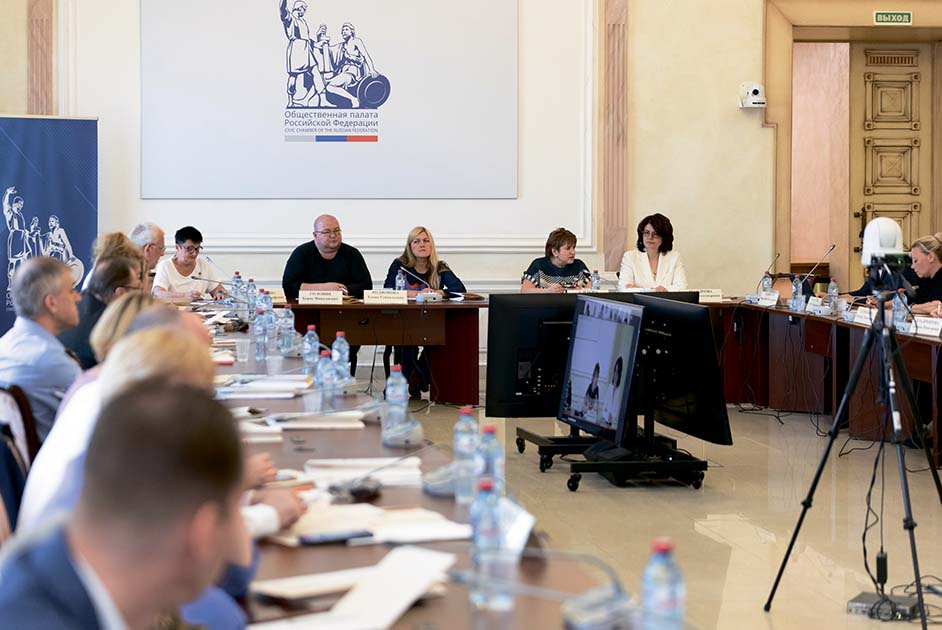 An important part of the work in this sphere for the Civic Chamber was participation in the creation and establishment of the Russian public-state movement of children and youth, "Movement of the First." June 2025 / Press Service of the Civic Chamber of the Russian Federation
In 2023, the building of the Civic Chamber of the Russian Federation turned 110 years old. It was built at the beginning of the 20th century on Miusskaya Square and originally housed the City Primary School named after Emperor Nicholas II.
The building became part of the educational cluster of the Miussy district, located alongside the modern Mendeleev University of Chemical Technology and the Russian State University for the Humanities.
During the Soviet period, it housed the Publishing House of Political Literature of the CPSU Central Committee ("Politizdat"). To meet the needs of the publishing house, the building was reconstructed: in the 1970s, two four-story annexes with elevators were added, and the territory partially lost historical elements in the name of the practical requirements of large-scale publishing activity. After the dissolution of the USSR, the publishing house ceased its activities for objective reasons, and part of the building's space was rented out.
In 2004, the building was reconstructed to meet the needs of the Civic Chamber of the Russian Federation.
The Civic Chamber is still located here, at 7 Miusskaya Square, and for 20 years has been a welcoming home for civil activists and their public initiatives and projects.
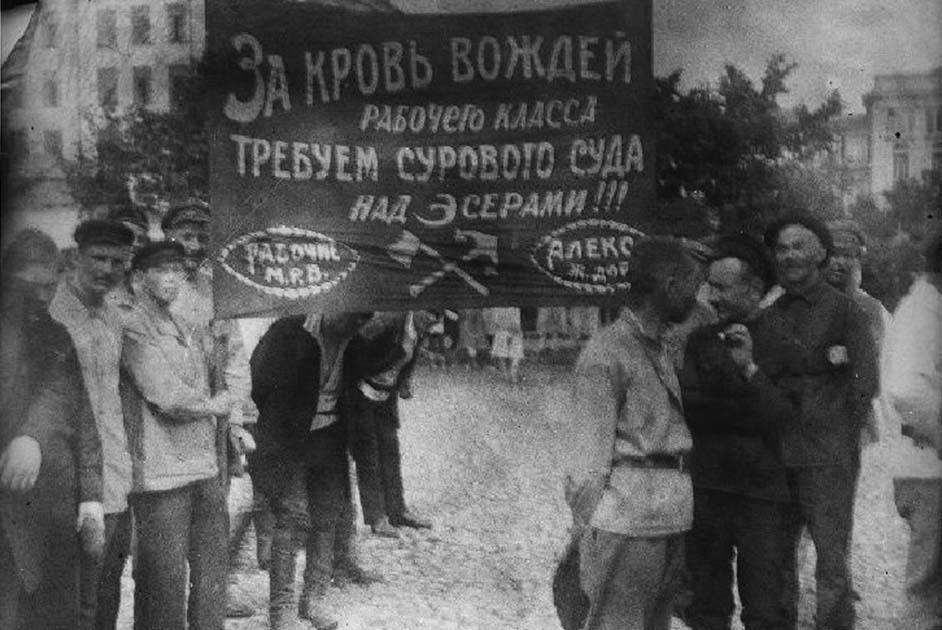 A workers' rally on Miusskaya Square protests Socialist-Revolutionary (SR) terrorism, following the assassinations of V. Volodarsky and M. Uritsky and the attempt on V. I. Lenin's life. August 30, 1918
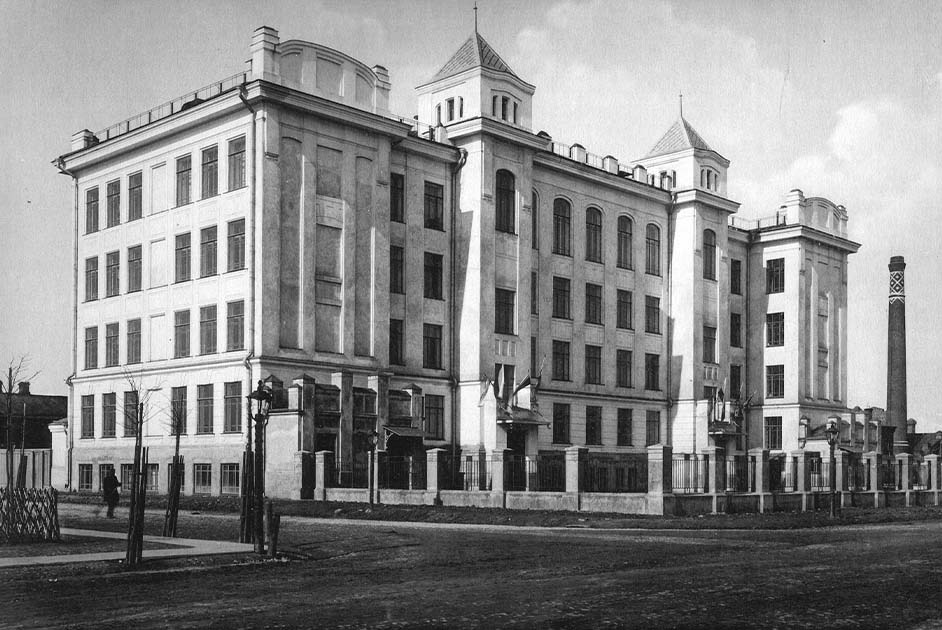 The City Primary School named after Emperor Nicholas II. 1913–1914.
Combating the Mass Spread of Fakes on
the Internet
For the past several years, experts of the Civic Chamber have repeatedly raised and discussed the issue of the uncontrolled spread of destructive content on social networks, noting that Russia needs to create its own "information shield" to protect the country's digital sovereignty.
To achieve this goal, the "Good News" project was launched in 2023 on the initiative of the Civic Chamber.
The idea for the "Good News" project originated at one of the "Community" forums in 2023, and its development involved broad public participation. The project aims to disseminate positive and verified information about Russia's achievements in diverse sectors, including science, education, economy, industry, healthcare, sports, culture, arts, digital technologies, and volunteering. The "Good News" project has fostered a community of like-minded individuals that continues to grow steadily.
Currently, over 29,000 good news stories have been published in the application, with more than 72,700 registered users who have performed over 634,400 interactions with positive content.
Adoption of the Law on Probation in the Russian Federation
The adoption of Federal Law No. 10-FZ of February 6, 2023, "On Probation in the Russian Federation," was a significant step in the field of convicted persons' resocialization and the culmination of years of public discussion, in which the Civic Chamber actively participated.
The Civic Chamber had raised the issue of systematic support for people released from penitentiary institutions, including their adaptation and reintegration into society, which requires a comprehensive approach beyond the criminal-executive system. After the law came into force, members of the Civic Chamber, during a meeting with the Minister of Justice of the Russian Federation, proposed specific measures for implementing the new provisions, highlighting successful practices from the nonprofit sector that could be replicated in several regions of Russia.
Life in the Online Era:
New Challenges and the Search for Solutions
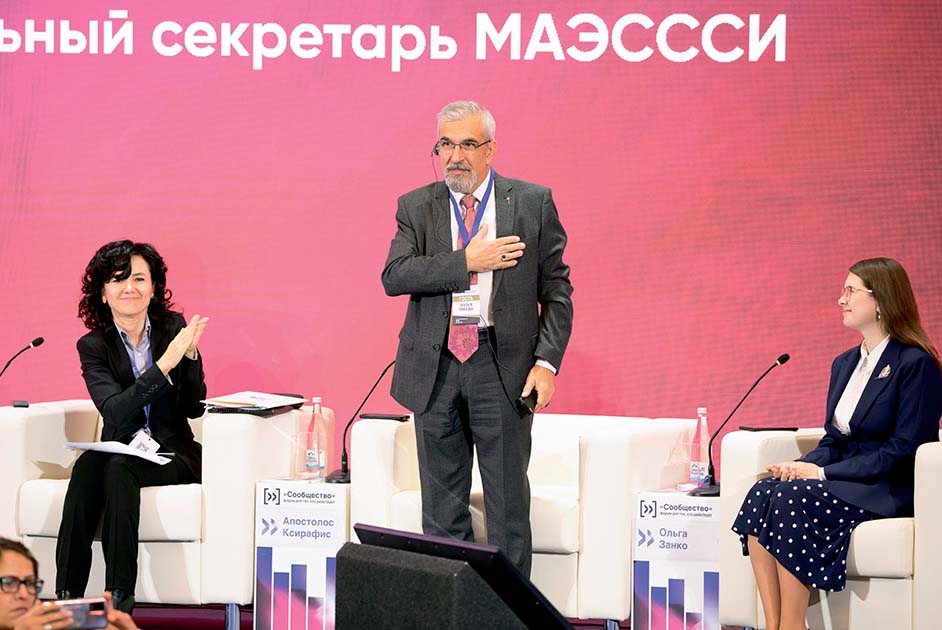 The Secretary-General of the International Association of Economic and Social Councils and Similar Institutions, Apostolos Xirafis, at the plenary session of the "Community" forum. November 2, 2023 / Press Service of the Civic Chamber of the Russian Federation
In November 2023, the two-year presidency of the Civic Chamber in the International Association of Economic and Social Councils and Similar Institutions concluded.
The outcome of the discussions held under the auspices of AICESIS in 2021–2023 was a report prepared by the Civic Chamber following its presidency in the organization, titled "Life in the Online Era: New Challenges and the Search for Solutions." This report was presented at the AICESIS General Assembly on November 1, 2023.
Within the framework of cooperation with international organizations, the Civic Chamber, as chair of AICESIS, in collaboration with representatives of other economic and social councils, accomplished the following in 2023:
- Prepared a report titled "Social Transition" for presentation at the 111th International Labor Conference held in Geneva from June 5–16, 2023.
- Prepared a report titled "Accelerating recovery from COVID-19 and the full implementation of the 2030 Agenda for Sustainable Development at all levels" for presentation at the UN High-Level Political Forum on Sustainable Development (HLPF) under the auspices of the Economic and Social Council (ECOSOC) in New York from July 15–21, 2023.
A key priority during the presidency of the Civic Chamber of the Russian Federation in the International Association of Economic and Social Councils and Similar Institutions (AICESIS) was the updating of the Association's Charter.
The aim was to enhance operational efficiency, strengthen the internal structure, intensify interaction among its members, attract new participating countries, and increase AICESIS's recognition and authority at the international level. A specially created working group, personally headed by the P of the Civic Chamber and President of AICESIS, Lidia Mikheeva, and including representatives from Benin, Guatemala, Greece, Spain, China, Luxembourg, Mali, Russia, France, and the Union of Economic and Social Councils of Africa, worked for two years to refine, modernize, and adapt the document to contemporary realities. Of note, the best Russian international lawyers from MGIMO and the National Research University Higher School of Economics were also involved in this work. The result was a balanced and transparent document aligned with AICESIS's current goals and objectives.
The final version of the Charter was unanimously approved at the General Assembly of AICESIS in Moscow on November 1, 2023.
Special Report on International Election Observation
In 2023, the Civic Chamber of the Russian Federation published its first special report in Russian and English, containing materials on the results of deploying 10 observation missions in 2022.
The report included forewords expressing support for the Civic Chamber's international observation missions from Russian Foreign Minister Sergey Lavrov and Chairperson of the Russian Central Election Commission Ella Pamfilova.
The report comprises findings from the Civic Chamber's observation missions during elections in Abkhazia, Angola, Kenya, Congo, Lebanon, Nepal, Senegal, Serbia, Tunisia, and South Ossetia.
Support by the President of Russia for the Initiatives of the
Civic Chamber
A meeting between the President of Russia and members of the Civic Chamber took place at the final "Community" forum.
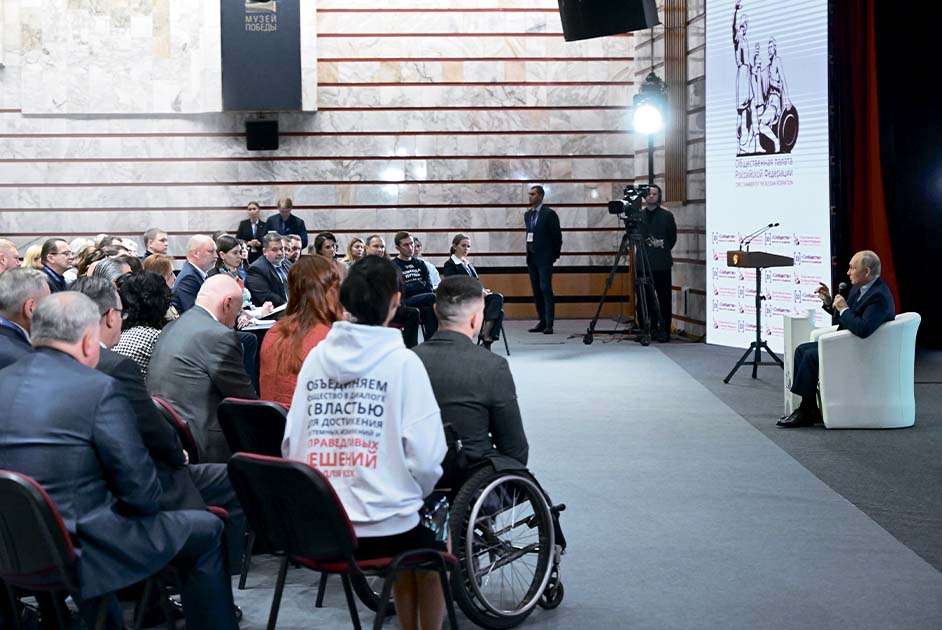 President of the Russian Federation Vladimir Putin during a meeting with members of the Civic Chamber of Russia at the Museum of the Great Patriotic War (Victory Museum) in Moscow. November 3, 2023. Sergey Guneev / RIA Novosti
Members of the Civic Chamber presented initiatives and proposals developed jointly with the expert community. Following the meeting, the President of Russia approved a List of Instructions, endorsing a significant portion of the Civic Chamber's initiatives. These included the following initiatives: comprehensive public monitoring of social rights observance in historical regions; the establishment of a creative cluster in Donetsk; the development of strategic planning documents in the field of demographic security; the improvement of traffic regulations; the implementation of the federal project "I am a Citizen of Russia"; the finalization of the draft law on the development of creative industries; and the creation of a museum dedicated to A.A. Zhdanov in Mariupol, among other projects. To date, the majority of these projects have been implemented.