Consolidation of Civil Society Institutions for Achieving National Development Goals
In implementing the instructions of the President of the Russian Federation following the Address to the Federal Assembly of the Russian Federation on April 21, 2021, the Civic Chamber of the Russian Federation acted as the coordinator of extensive work to consolidate the efforts of civil society institutions in order to participate in developing solutions for achieving national development goals and improving the mechanisms for implementing national projects. On the basis of the Coordinating Council under the Civic Chamber for National Projects and Population Sustainability, a broad expert-public platform was formed, uniting representatives of nonprofit organizations, the expert community, civil activists, and specialized professionals.
The main task was not merely to discuss but to develop concrete proposals for adjusting and improving key national projects—from healthcare and education to ecology, science, infrastructure, and demography. All initiatives were result-oriented, with success measurable by the quality of people's lives.
The Civic Chamber's proposals received the support of the President of Russia and the Government of Russia: representatives of the Coordinating Council joined the public-expert councils under the project committees, and a number of initiatives formed the basis of instructions to federal authorities.
Furthermore, the Civic Chamber formed a package of new proposals in the spheres of healthcare, education, ecology, digital transformation, and demography, expanding the scope of the national agenda and confirming the role of civil society as a full-fledged participant in strategic planning.
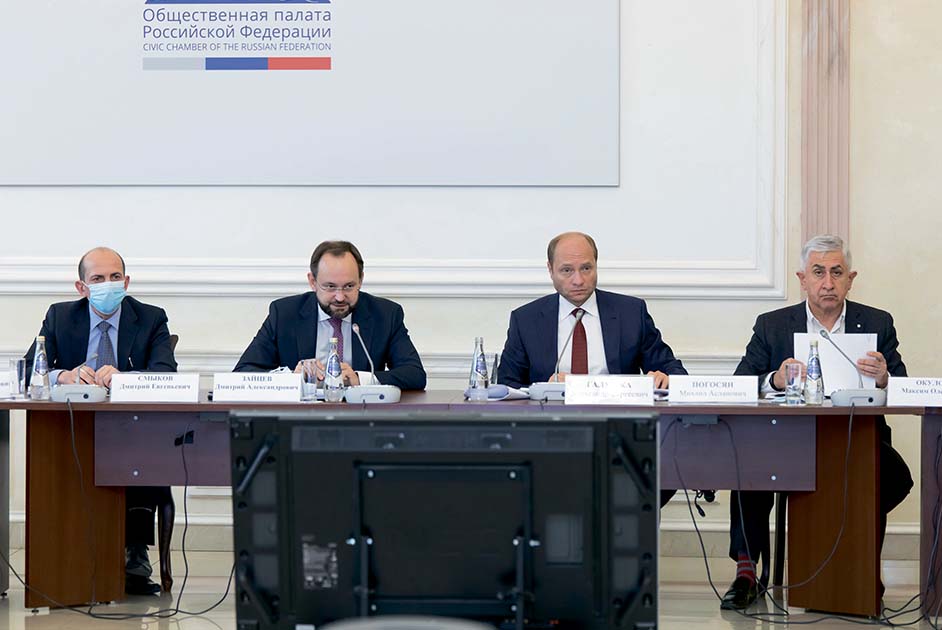 Vice President of the Civic Chamber of the Russian Federation, Chair of the Coordinating Council under the Civic Chamber for National Projects and Population Sustainability, Alexander Galushka during a council meeting dedicated to adjusting national projects. October 21, 2020 / Press Service of the Civic Chamber of the Russian Federation
"Circle of Kindness" Foundation for Supporting Children with Severe Illnesses
President of Russia Vladimir Putin proposed creating a charitable foundation to assist children with serious and rare diseases, to be funded through an increased tax rate on the incomes of the country's wealthy citizens.
On the platform of the Civic Chamber, the concept, structure, and key foundational documents were developed. The foundation was headed by Civic Chamber member, priest Alexander Tkachenko.
In its first year of operation, the foundation helped over 2,000 children, providing treatment worth more than 31 billion rubles. Children with serious and rare diseases received expensive therapy funded by Russian taxpayers. The foundation's model was unique on a global scale: revenues from taxes on citizens' excess incomes were purposefully directed towards treatment and, quite literally, saving children's lives.
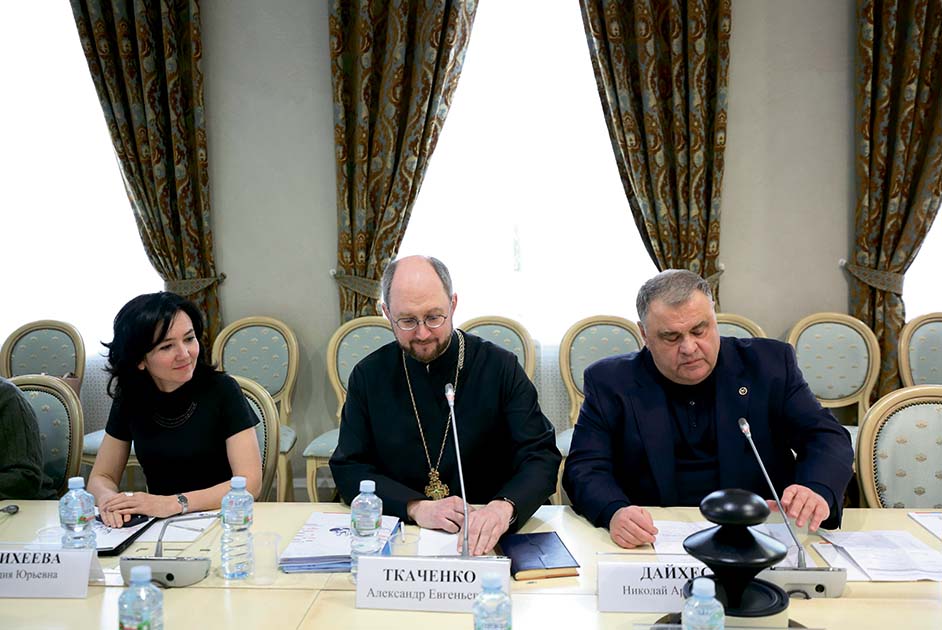 Members of the Civic Chamber Lidia Mikheeva, Alexander Tkachenko, and Nikolay Daykhes at a meeting of the Board of Trustees of the "Circle of Good" Charitable Foundation. March 2021 / Press Service of the Civic Chamber of the Russian Federation
Access for Volunteers to Hospitals and Clinics
In 2021, due to the increasing cases of social and medical institutions refusing volunteer assistance because of coronavirus restrictions, the Civic Chamber—with broad participation from representatives of state authorities, public organizations and associations, the scientific and expert community—examined the main problematic issues in organizing volunteer work in the healthcare sphere.
Recommendations for further aligning interests and eliminating restrictions on volunteer work in healthcare institutions were submitted to the relevant ministries and departments.
These recommendations were subsequently taken into account during the development of corresponding methodological guidelines and standards for organizing volunteer activities.
"Reset" of the Russian Red Cross
The large-scale reform of the Russian Red Cross (RRC) became clear evidence of the maturity of civil society. The Civic Chamber, assuming the role of guarantor, expert, and talent donor for the country's main humanitarian organization, emerged as one of the key participants in this "reset."
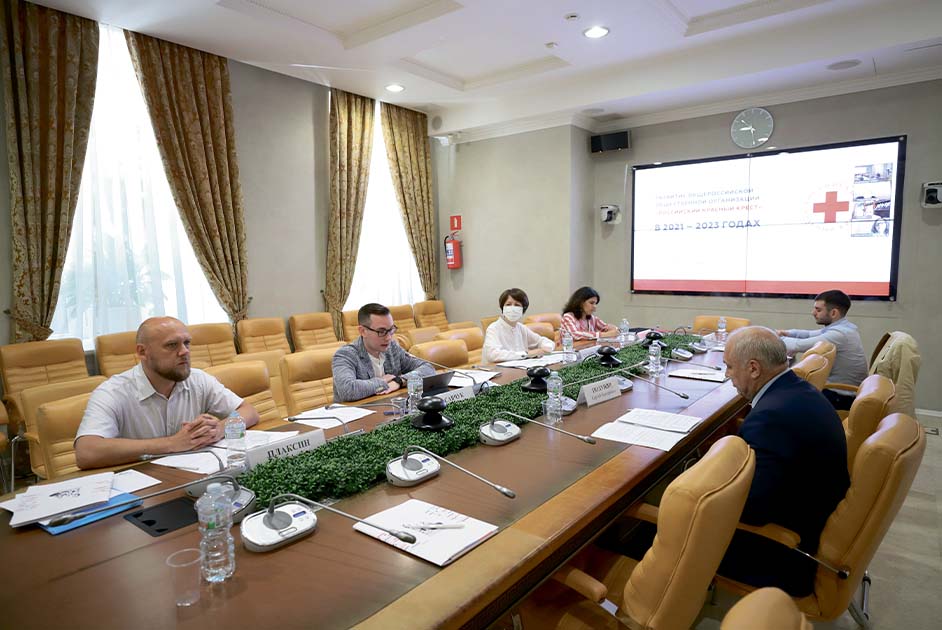 Public Expert Review of the Draft Federal Law "On the Russian Red Cross." June 24, 2021 / Press Service of the Civic Chamber of the Russian Federation
For a long time, the Russian Red Cross, while possessing a colossal historical legacy, needed an update of its management approaches and legal status. The Civic Chamber became the platform that could unite the interests of the state, the medical community, and volunteer movements.
The election of Pavel Savchuk, a member of the Civic Chamber and leader of the "Medical Volunteers" movement, as Chair of the RRC became a symbol of the organization's systemic renewal—his crisis management experience, proven during the pandemic and the #WeAreTogether campaign, allowed for the introduction of transparency principles and efficiency standards, adopted in the Civic Chamber, into the Red Cross. The Civic Chamber, in cooperation with regional chambers across Russia, provided the RRC with significant organizational support.
The XVII Congress of the Red Cross, where the new development strategy was approved and governing bodies were elected, was conducted in a unique format. To ensure maximum legitimacy of the decisions made and to account for the opinion of every region, delegates gathered in regional civic chambers. Thus, the Civic Chamber not only performed a technical function by providing the necessary infrastructure for the congress but also ensured full methodological support for the event, guaranteeing the legality and compliance of all procedures with the organization's foundational documents.
Later, in June 2021, a public expert review of the draft federal law "On the Russian Red Cross" was conducted. Civic Chamber experts meticulously worked on the document, advocating for the interests of beneficiaries and volunteers.
Today, looking at the active work of the renewed Red Cross, we see the result of the work done: this includes aid to residents of the Donbass republics, Zaporozhye and Kherson oblast, Belgorod and Kursk oblasts literally from the first days of the Special Military Operation; support for victims of conflicts in Syria and Karabakh, efforts in the field of blood and bone marrow donation, work with forced migrants, and much more.
Unified Mechanism for Supporting Socially Oriented NPOs
Amid the pandemic, on the initiative of the Civic Chamber, NPOs were included in the list of recipients of anti-crisis measures alongside small and medium-sized businesses.
A key step was the creation of a unified registry of SO NPOs, formalized by federal law and a Resolution of the Government of Russia. Thus, supporting organizations could count on a tax deduction, and the NPOs themselves gained a more transparent and fair accounting mechanism.
Upon the Civic Chamber's proposal, the criteria for inclusion in the registry of socially oriented nonprofit organizations were expanded: from that moment, not only recipients of property support but also organizations recommended by the constituent entities of the Russian Federation could be included. Furthermore, the Civic Chamber secured the right to initiate a review of decisions regarding the inclusion or non-inclusion of an NPO in the registry, with a mandatory response from the authorized bodies.
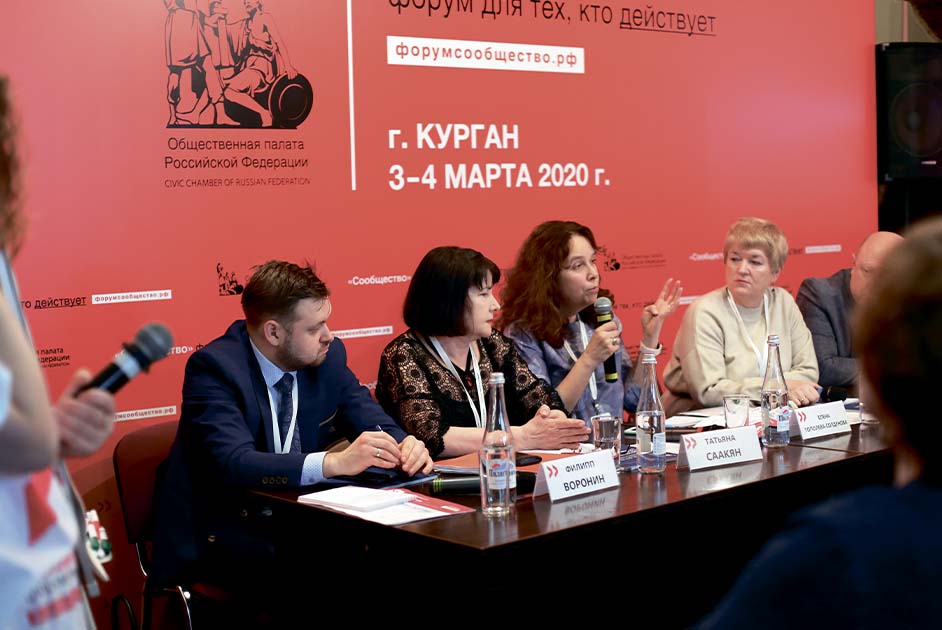 Co-working space "#RegionNPO in the Kurgan Oblast" as part of the "Community" forum in Kurgan. March 3, 2020 / Press Service of the Civic Chamber of the Russian Federation
Protection of Citizens' Rights and Public Interests in the Digital Environment
The Civic Chamber has always been a place for active discussion of issues related to the development of internet space and the digital environment. Civic Chamber's members, experts, and government representatives have grappled with the question of how to make online communications safer and more responsible, and how to protect children from harmful content. In 2021, this dialog continued. Particular attention was paid to combating digital fraud and protecting the rights of participants in civil transactions in the sphere of online dealings, including real estate operations. The developed initiatives became part of efforts to form a systemic policy in digital security.
However, one of the most resonant and acute topics on the digital agenda in 2021 was child protection on the Internet. Noting the special attention the President of Russia pays to this issue, the Civic Chamber initiated a broad public discussion of the threats children face in the digital environment, including harmful content and its impact on minors' mental health.
The result of this work was the "Memorandum of the Parental Community on Protecting Children on the Internet and Social Media," prepared with the participation of public organizations and experts. This document not only outlined the issues but also became a unifying signal for business, the state, and society.
In September 2021, leading Russian internet companies, media holdings, and telecom operators signed a charter on child safety on the Internet. The Civic Chamber supported this initiative, emphasizing that the participation of digital platforms in regulating internet space is a key condition for countering the spread of unlawful content.
Another important area in this sphere was the Civic Chamber's participation in shaping ethical principles for the development and implementation of technologies based on artificial intelligence.
Thus, together with representatives of the IT industry, the scientific community, and civil institutions, the concept of regulating digital ethics principles was discussed.
In particular, in October 2021, at the First International Forum "Ethics of Artificial Intelligence: The Beginning of Trust," the AI Ethics Code was signed—the first document of its kind to establish voluntary self-regulation principles in the high-tech sphere.
The Civic Chamber supported this initiative as an important step towards forming responsible interaction between humans and artificial intelligence, and the Code itself was recognized as a key element of future digital sustainability and trust in society.
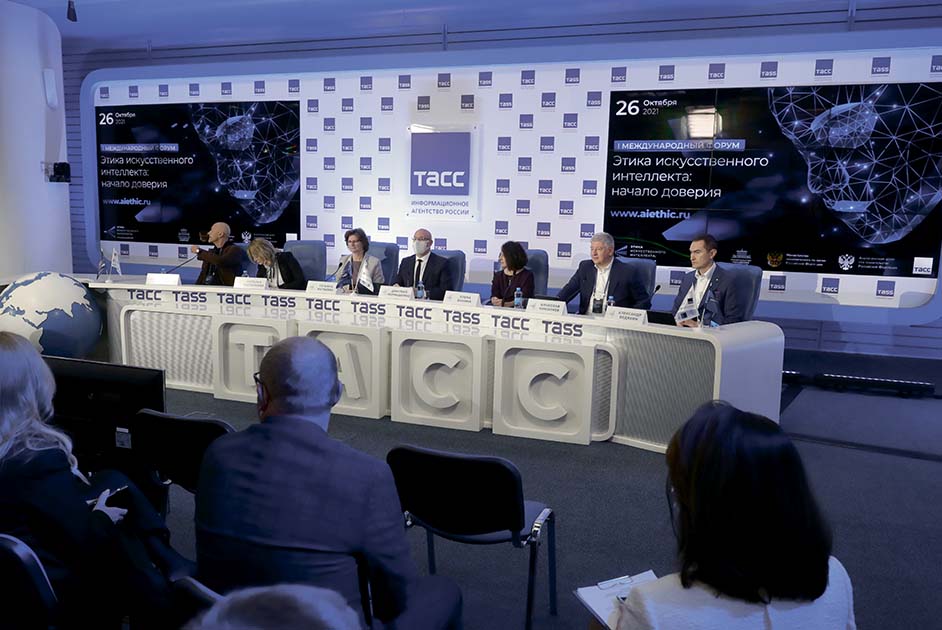 International Forum "Ethics of Artificial Intelligence: The Beginning of Trust" in Moscow. October 26, 2021. Mikhail Dzhaparidze / TASS
Assistance in Finding Missing Persons
Acknowledging the high importance of volunteer work in searching for missing persons, the Civic Chamber in 2020–2021 conducted a series of events on improving the legislation of the Russian Federation regarding determining the location of subscribers' mobile phones for the purpose of rapid search operations.
The debate on whether or not data from a person's mobile device can be disclosed if they go missing lasted for many months. The Civic Chamber submitted its proposals, which were taken into account by the State Duma during the adoption of the corresponding federal law.
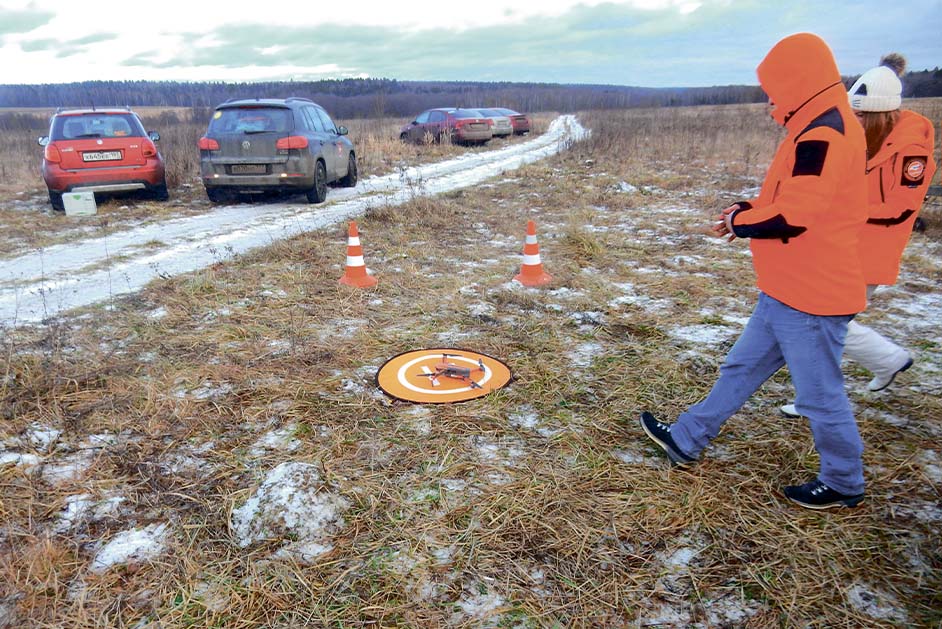 Launch of a quadcopter during search training exercises. January 5, 2020 / Press Service of the "LizaAlert" volunteer search and rescue team
Rating of Public Councils under Federal Executive Bodies
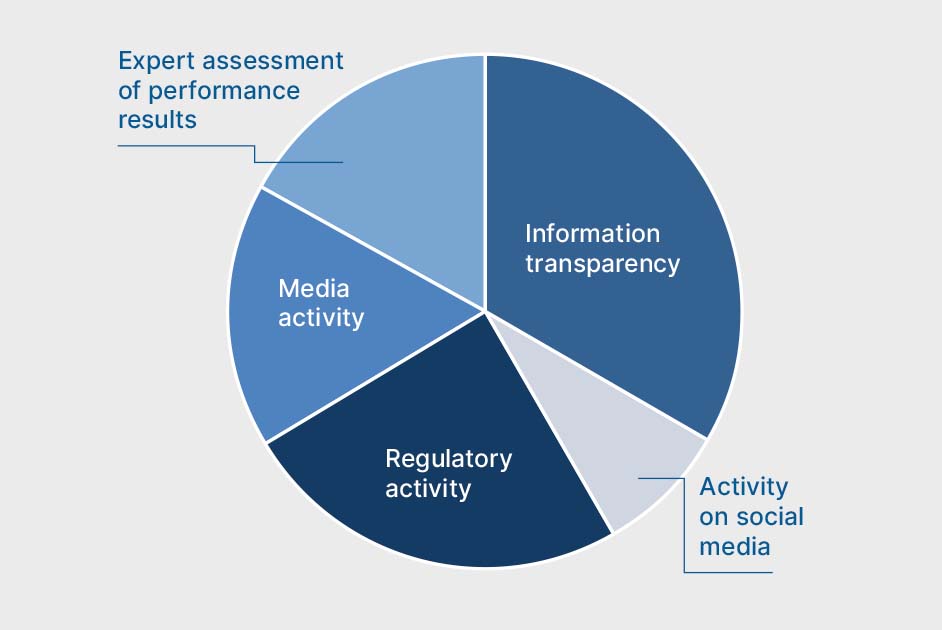
Since 2021, the Civic Chamber has begun compiling an annual rating of public councils under federal executive authorities overseen by the Government of the Russian Federation.
The conducted rating studies have proven themselves as an effective mechanism for expert assessment, motivation for development, transparency, and improving the quality of work of civil society institutions.
The work of public councils was measured and evaluated throughout the year across many indicators, allowing council members, ministries, and agencies to build their interaction more purposefully. The rating leaders—public councils under the Ministry of Construction, the Ministry of Agriculture, and the Ministry of Education and Science—became benchmarks for councils under other government bodies.