Volunteer’s Day Established in Russia
A new state approach to supporting the volunteer movement.
The impetus for the systemic development of the volunteer movement was the President’s Address to the Federal Assembly on December 1, 2016, in which he emphasized the need to eliminate all barriers impeding the growth of volunteerism.
The Civic Chamber, having long served as a key platform on volunteerism development, intensified its work in this area. Members of the Civic Chamber collected and systematized over 300 successful practices for supporting volunteers, analyzed them, and based on this, prepared a Standard for Supporting Volunteer Activities.
The document proposed unified approaches to eliminating administrative and organizational barriers to volunteer activities across the country. Alongside this, preparing proposals for amending the law on charitable activities was also significant. The Civic Chamber organized a broad public discussion of the amendments to the law. Public hearings were held in the vast majority of the country’s regions.
The result was the formal recognition of volunteers as subjects of charitable activity, which finally legitimized the volunteer movement in Russia.
According to sociological surveys, millions of the country’s citizens considered themselves volunteers and/or benefactors. As early as mid-2018, the UN would call Russia the "largest volunteer nation."
At the end of 2017, the President of Russia signed a Decree declaring December 5 as Volunteer’s Day and proclaimed 2018 the Year of the Volunteer.
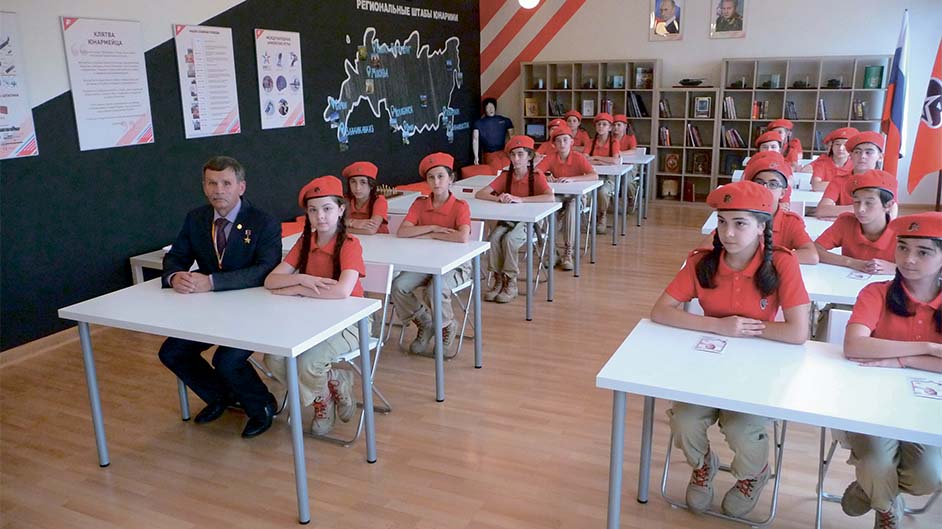 First Vice President of the Civic Chamber, Hero of Russia Vyacheslav Bocharov participates in a lesson alongside activists of the youth military-patriotic movement "Yunarmiya" / Press Service of the Civic Chamber of the Russian Federation
"Marathon of Good Deeds". Mediation of Environmental Conflicts
2017 was declared the Year of Ecology in Russia.
The large-scale environmental agenda initiated by the President of Russia united the efforts of the authorities and civil society institutions. Within this framework, the Civic Chamber launched the nationwide "Marathon of Good Deeds" campaign. The project brought together activists, students, professional communities, and environmental NPOs, becoming one of the largest volunteer initiatives in the field of environmental protection. The campaign demonstrated that citizens’ environmental demands could transform into a sustainable and mass form of participation in the country’s life.
Simultaneously, 2017 saw an increase in conflict situations related to environmental policy, primarily in the context of launching the "waste reform." Here, the Civic Chamber acted as a public mediator, facilitating dialog between the authorities and the population, seeking to mitigate tensions and find compromises.
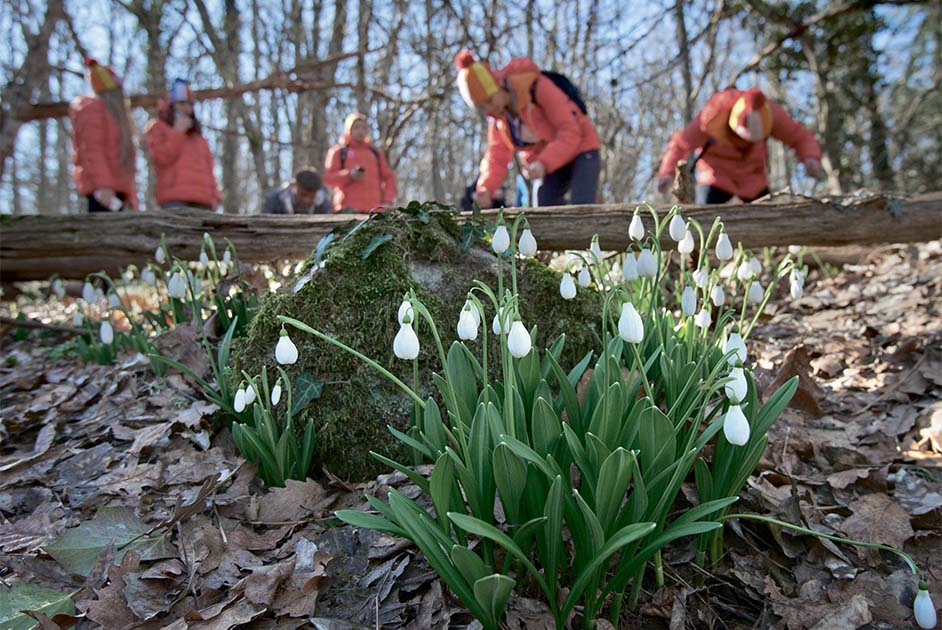 Artek campers during an ascent of Bear Mountain and a cleanup of the ecological trail. March 4, 2017. Sergey Malgavko / RIA Novosti
Record Funding Volume for Social Projects
A unified operator for state support of NPOs was created—the Presidential Grants Foundation.
Until 2017, the system of state support for NPOs was fragmented, and access to information about grants and subsidies was limited.
The establishment in 2017 of the Presidential Grants Foundation—a unified operator for presidential grants—provided an impetus for the development of civic initiatives across the country.
From its inception and in subsequent years, the Foundation became not just an administrator but a genuine engine of positive change, supporting projects in a wide range of spheres—from culture and science to ecology and charity—directing significant funds towards implementing socially significant projects and ensuring transparency and systematic allocation of funds.
Already in 2017, the Foundation distributed over 6 billion rubles among 3,213 SO NPOs. In 2018, 8 billion rubles were allocated through the presidential grants program. Projects submitted by NPOs working across 13 areas in the fields of social protection, healthcare, education and science, and youth policy competed for grants. A new area—"Identifying and Supporting Young Talents in Culture and the Arts"—was introduced in 2018.
In the first years of the Foundation’s operation, the geography of support expanded, with the focus shifting from Moscow and St. Petersburg to the regions of the Russian Federation. For instance, following two competitions in 2018, projects from all 85 regions of the country received support. More than half of the supported NPOs (1,049) received a presidential grant for the first time. Compared to 2015, the number of supported regional projects quadrupled. The number of winning projects from small towns and rural areas also increased, with 1,068 organizations receiving grants totaling over 1.2 billion rubles in 2018 (20% more than in 2017).
The platform’s success was evident and allowed for refining the grant allocation system and creating new development institutions: in 2021, the Presidential Foundation for Cultural Initiatives began its operations under the leadership of media manager Roman Karmanov, and in 2025, the Presidential Foundation for Nature was established, also headed by Ilya Chukalin.
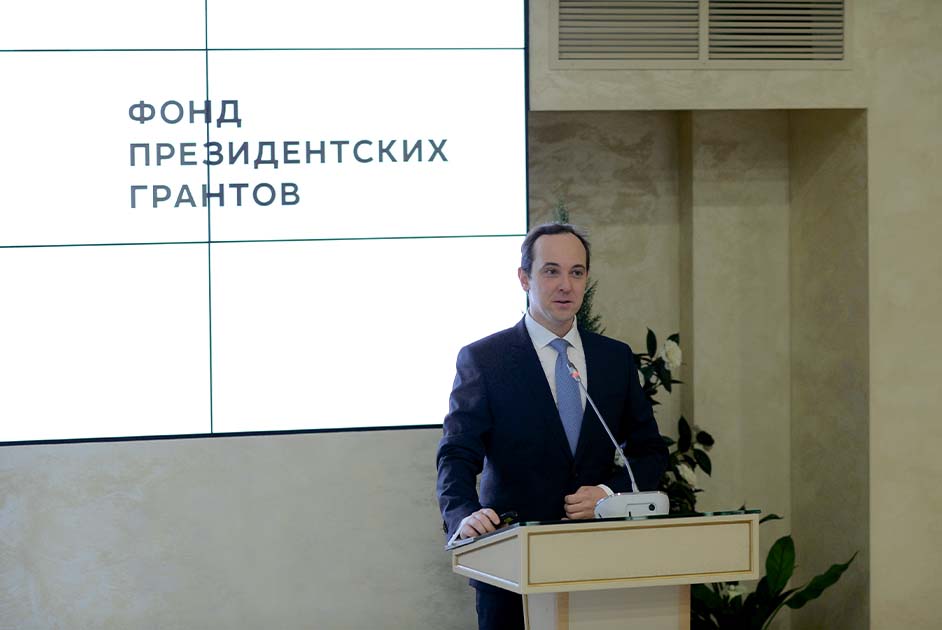 General Director of the Presidential Grants Foundation Ilya Chukalin addresses participants of the seminar "How to Receive a Presidential Grant of the Russian Federation for Implementing a Social Project?". March 5, 2018 / Press Service of the Civic Chamber of the Russian Federation